Nilometer

Luxor is ancient Thebes and has a fascinating past. Share your knowledge or ask your questions here.

Moderators: DJKeefy, 4u Network

Post Reply
User avatar
DJKeefy
Site Administrator
Site Administrator
Posts: 11035
Joined: Thu Jan 13, 2005 4:08 pm
Location: UK
Has thanked: 665 times
Been thanked: 1239 times
Gender:
Contact:
Egypt

Nilometer

Post by DJKeefy »

In ancient Egypt, the behavior of the Nile could mean life or death each harvest season. So, long before the Aswan Dam was constructed to manage the flooding of the great river, Egyptians invented an instrument to measure the waters in order to predict the Nile’s behavior: the nilometer.

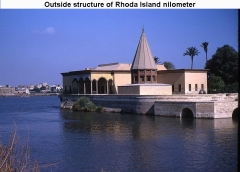
There were three kinds of nilometers, and examples of all three can still be seen around Egypt. The simplest was a tall column housed in a submerged stone structure called a stilling well. One of these nilometers can be seen on Rhoda (or Rawda) Island in Cairo, an octagonal marble column held in place by a wooden beam at the top that spans the width of the well. The stilling well included a staircase so that priests, who were in charge of monitoring the nilometers, could walk down and examine the column.

Nilometers were used for measuring water levels as early as 5,000 years ago. The nilometer on Rhoda Island dates back to 861, when it was built where an older nilometer had been, based on a design by Afraganus, a famous astronomer. The massive measuring stick had markings on it to indicate where the water level was at any given time, information the priests would use to determine what conditions the future held: draught, which would mean famine; desirable, which would mean just enough overflow to leave good soil for farming; or flood, which could be catastrophic.

Only priests and rulers, whether pharaohs or later, Roman or Arab leaders, were allowed to monitor the nilometers, and their ability to predict the behavior of the Nile was used to impress the common people. (And to determine how much money would be collected in taxes.) This is why so many nilometers were built in temples, where only priests would be able to access the mysterious instrument.
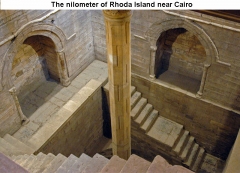
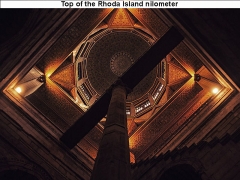
14709 14710 14711

The nilometer on Rhoda Island is today housed in a modernized building. The conical roof replaced an older dome that was destroyed in 1825 during the French occupation. The interior is ornately carved, and three tunnels that once let water into the stilling well at different levels have been filled in, so visitors can walk all the way down.
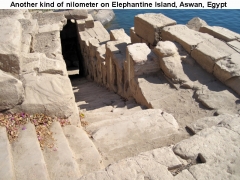
14712 14713

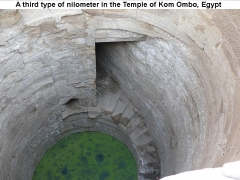
Another type of nilometer, like the one that can be seen on Elephantine Island in Aswan, had evenly spaced steps that lead straight down to the Nile, and indicator markings on the walls at different levels for each step. This one was often the first to indicate what conditions to expect, being located near Egypt’s southern border. The third kind, an example of which can be seen at Temple of Kom Ombo, a little further north, brought the water away from the Nile by way of a canal that deposited it into a cistern. And again, the indicating markers were carved into the wall, accessible by staircases for the priests and rulers who predicted the fate of the Egyptian crop.

Source: http://www.atlasobscura.com/places/nilometer


Image
User avatar
John Landon
V.I.P
V.I.P
Posts: 1025
Joined: Thu Dec 08, 2016 2:50 pm
Has thanked: 1605 times
Been thanked: 632 times
Venezuela

Re: Nilometer

Post by John Landon »

Why didnt they just look at the Nile to determine its height ?

I used to live on the banks of the river Dee, and that what we used to do. we didnt need a Deeometer...
If it got to my back garden, I was happy, I got my septic tank flushed out and emptied for free...... 8)
Don't look back. That's not the direction you are travelling towards.
newcastle
Egyptian God
Egyptian God
Posts: 8695
Joined: Thu Oct 17, 2013 11:49 am
Has thanked: 1548 times
Been thanked: 5127 times
Contact:
Egypt

Re: Nilometer

Post by newcastle »

John Landon wrote:Why didnt they just look at the Nile to determine its height ?

I used to live on the banks of the river Dee, and that what we used to do. we didnt need a Deeometer...
If it got to my back garden, I was happy, I got my septic tank flushed out and emptied for free...... 8)
My thoughts exactly!

There was bugger all they could do if the monsoon rains in Ethiopia left the Nile unusually low or high...and I can't see that the Nilometer would have given them much in the way of a forecast.

I suppose the level of deviation from the ideal may have enabled the authorities to adjust taxation on some sort of standard basis. It will also have given some basis to a historical record system...enabling them to correlate low/high levels with likely results in terms of famine/ flood damage.

Otherwise...a device to bolster the mumbo-jumbo associated with the priesthood then....and ever since :urm:
newcastle
Egyptian God
Egyptian God
Posts: 8695
Joined: Thu Oct 17, 2013 11:49 am
Has thanked: 1548 times
Been thanked: 5127 times
Contact:
Egypt

Re: Nilometer

Post by newcastle »

An update on this topic.

"Essentially, apart from such ritual functions they may have served in ancient Egypt, nilometers worked on the Goldilocks principle as far as the rulers of Egypt were concerned. If the water level in August–September was too high, the effects on the narrow band of fields either side of the river, and the surrounding infrastructure, would be devastating and there was no point sending out the tax collectors. If the water level was too low, the population would starve, and there was also no point sending out the tax collectors. If the water level was just right, a rich layer of alluvial silt would be deposited as the flood subsided, crops would grow, and off would go the tax collectors, no doubt singing merrily to themselves."

http://imagesofcenturies.com/2017/07/12 ... /#more-532

This is an interesting (to me anyway!) , if lengthy, article...with some excellent pictures.
User avatar
Horus
Egyptian God
Egyptian God
Posts: 7933
Joined: Tue Oct 10, 2006 11:59 pm
Location: UK
Has thanked: 2431 times
Been thanked: 1870 times
Gender:
Contact:
United Kingdom

Re: Nilometer

Post by Horus »

I have always held the view that Nilometers were more to do with taxation than anything else, it would also serve as an earlier indicator of a famine, so no doubt allow the authorities to release grain from the storehouses early enough to alleviate the situation. As the amount of arable land was unlikely to change, it would only be the water level that could determine the total area in which crops could be grown and as it was the priests who would re-establish each owners boundaries after each inundation, then it stands to reason that they had excellent records of the agricultural land. Knowing the height of the Nile would allow them to know quite accurately (by referring to their records) exactly how much land was underwater even with an irregular shaped waterline.

They could even go one further and predict future famines by for example observing several low levels which resulted in just enough to feed the people, but no surplus grain being produced, thus lowering the reserves on a yearly basis, So even if the population was not starving they (the priests) would be aware that say in year 5 there would not be enough grain to feed the population as the reserves were steadily used up to fill any shortfall. It may even extend further by allowing Pharaoh to know if or not he would have income from taxation to wage war or to be unable to carry out his building work if the Nile was too low to transport stone from the quarries. We all know that the ancient Egyptians were very clever and capable people, so I am sure there is more to these devices than just measuring the height of water.
Image
Post Reply